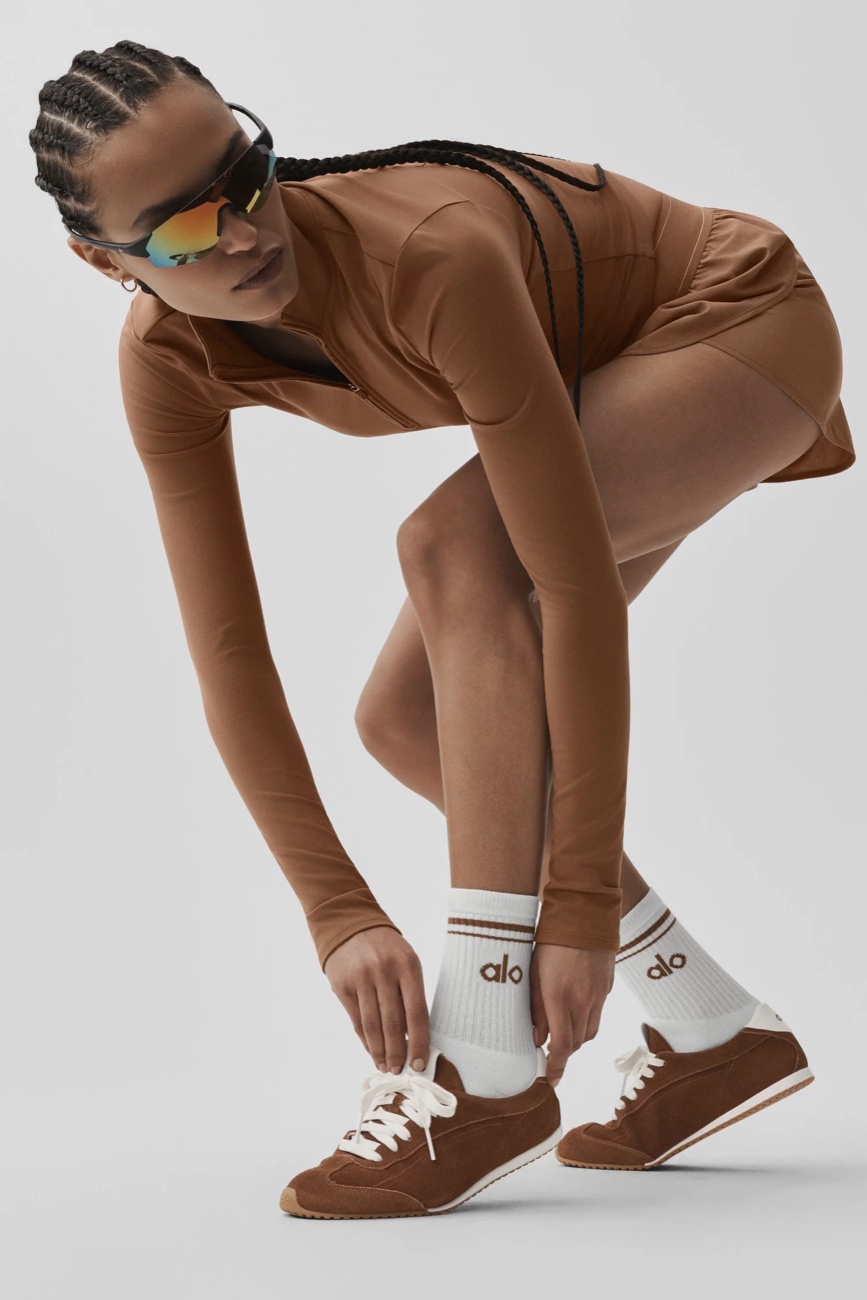
Yoga wear & activewear manufacturer — leggings, bras and sets (OEM & ODM)
Yoga and studio activewear lives or dies on hand-feel, opacity and four-way stretch. We manufacture high-rise leggings, sculpting sports bras, tanks and matching sets on flatlock and four-needle six-thread sewing lines, with bonded waistbands and gusseted crotches. Opacity should be checked against the approved fabric, color, fit and movement protocol rather than inferred from construction alone.
For leggings and bike shorts, use the waistband roll-down, gaping and fit guide to specify band architecture, top/bottom openings, negative ease, elastic or seamless zones, rise/gusset interaction, grade and movement approval.
When the brief asks for “no front seam” or “camel-toe proof,” use the no-front-seam leggings manufacturing guide to separate the consumer phrase from front/back rise, crotch extension, gusset geometry, fabric behavior, respectful fit review and evidence-bounded claims. Removing one seam is not a universal fit guarantee.
For tanks with integrated support, use the built-in-bra tank manufacturing guide to distinguish the outer shell, shelf or bra frame, underbust elastic, removable/fixed/molded cup route, pad pocket, straps, coverage, fit, movement and care evidence. “Built-in bra” is a product family, not one universal construction or support class.
For visible, hidden or seamless scrunch leggings, use the scrunch seam, fit and testing guide to define the center-back structure, gathering component, back rise, gusset, grade, local extension and complete-garment movement checks instead of asking a factory to copy a social-media photo.
For Pilates, barre, yoga and reformer grip socks, use the grip sock manufacturing guide to separate foot-to-sock hold from sock-to-surface traction. It covers graded fit, toe/heel/cuff construction, knit and terry zones, exact silicone deposits, original grip artwork, nominated studio surfaces, wash durability and claim boundaries rather than treating “non-slip” as a universal certificate.
The fabrics in this category
The styles in our gallery run on the blends buyers actually ask for in this segment:
- Buttery nylon–spandex (78% Nylon 22% Spandex, up to 67/33) — a smooth, close-to-skin handle; composition alone does not establish compression, support or recovery
- Modal and viscose blends (95% Modal 5% Spandex, 95% Viscose 5% Elastane) — soft-drape tanks and loungewear crossovers
- Poly–cotton–rayon tri-blends (46/44/10) and cotton–spandex jersey — breathable studio tops and relaxed sets
Use the activewear nylon vs polyester vs spandex guide to compare these as material starting points, not performance rankings. Fiber percentage does not prove a buttery hand, breathability, compression, opacity or recovery.
GSM is only fabric mass per area; it does not prove opacity, support or recovery. Use the activewear GSM and stretch guide to compare weight, elongation, fabric power, growth and wash stability before approving a custom fabric.
Before bulk cutting, use the activewear fabric inspection checklist to control roll identity, visual defects, usable width, GSM, shade groups, bow/skew and cutting allocation separately from final-garment AQL.
For leggings and bike shorts, use the activewear opacity and squat-proof testing guide to define the working extension, background, lighting, risk zones, movements and visible acceptance rule.
For all-over legging artwork or placement graphics, use the activewear printing guide to compare sublimation, screen print, heat transfer and DTF by the actual fabric, base color, extension, hand and care risk—not by a retail image.
For a compressive fit, use the compression activewear stretch, recovery and pressure guide to separate fabric power from finished-garment pressure and any wearer-benefit claim.
For sports bras, use the sports bra support testing guide to keep static fit, breast-motion reduction, strap/underband pressure, wearer perception and support after care as separate approval decisions.
For a custom size range, use the activewear size grading and fit approval checklist to control the base-size POMs, grade rules, movement checks and size-set decision before bulk cutting.
For studio-to-street flares, use the flare leggings manufacturing, inseam and hem guide to specify short/regular/tall length options, knee and flare-break landmarks, hem opening, footwear clearance, twisting and after-care fit instead of ordering from a retail length label alone.
For leggings with side, waistband, zip or mesh storage, use the pocket manufacturing and phone-load test guide to control usable internal size, target phone/case mass, opening, retention, access, waistband pull, leg rotation, local opacity and wash retesting.
An exercise or active dress is not just a longer top: the outer skirt, torso, inner shorts or bodysuit, pockets, optional bra, leg finish and access route interact. Use the tennis and active dress manufacturing guide to define and test that complete system.
OEM vs ODM
Send a tech pack or approved sample for OEM, or start from concept and let our in-house design team and fabric library build the range for ODM. See OEM vs ODM for activewear to decide.
MOQ, sampling and lead time
Full custom MOQ starts from 200 pcs per color and style, sampling takes 7–10 working days, and bulk production takes 30–45 days after confirmation. Brands that do not need product changes can instead request the private ready-style Excel catalogue from 50 pcs per style.
Certification requirements depend on the buyer, destination and exact BOM. Verify the product class and certified article/components before relying on OEKO-TEX STANDARD 100, and verify the exact process, chemical or article designation rather than inferring coverage from a bluesign partner logo. Use the chemical-compliance checklist and eco-certification comparison before approving order evidence.
As a factory-direct group that owns its mills and cut-and-sew lines, your fit and quality stay under one roof — tour the factories.
Send your leggings or bra tech pack to Jerry for a same-week sample quote.